Learn | Explore | Connect

at the University of Toronto

  • About Us
    • About Us
    • Our Mission
    • Personnel
  • Events
    • Events
    • Past Events
  • Funding
    • Funding
    • Phool Maya Chen Scholarship
    • Machik Ödrön Fund for Tibetan Language
    • Bill and Belle Levman Graduate Award
  • Programs
    • Learning Languages
      • Tibetan Studies
    • The Circled Square Podcast
    • Engaging Education in Buddhist Studies
    • Canadian Journal of Buddhist Studies
    • Mentoring Matters
    • Student Flourishing
  • Community
    • Faculty & Teaching Staff
    • Post Doctoral Fellow
    • Research Partners
    • Students
    • Alumni
  • Emaho! Blog
You are here: Home / Archives for uoftcbs

April 27, 2026

Zen Sower

Submitted by Samuel Li

A soft afternoon light pooled over campus when my phone buzzed, a friend texted “Zen talk at U of T this weekend—Wanna come?”

When the mic clicked on, I leaned forward like everyone else, ready for a silver bullet. What I got instead was a pause long enough to hear my own wanting. And then, a lesson about desire.
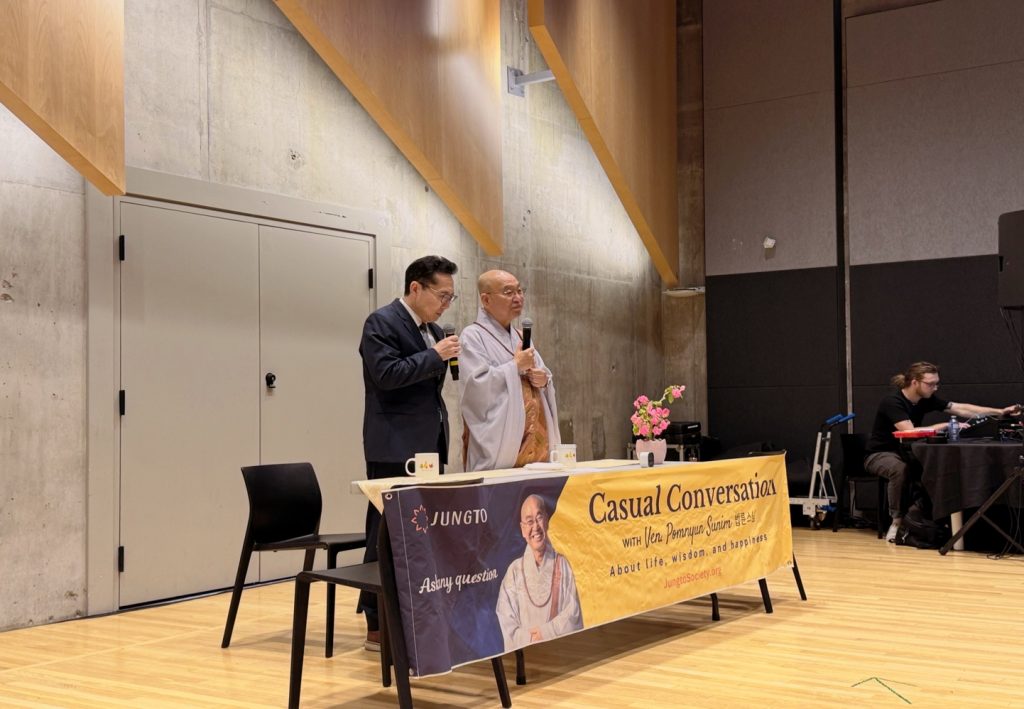
Ven. Pomnyun Sunim offering welcome remarks as interpreter Jason Lim translates Korean into English. Photo by Sinae Kim.

On September 28, 2025, the Robert H. N. Ho Family Foundation Centre for Buddhist Studies at the University of Toronto (HCBS) hosted a Dharma Q&A with Venerable Pomnyun Sunim, renowned Korean Zen master and founder of Jungto Society. During the 90-minute session, audience members were invited to ask questions directly to Ven. Pomnyun Sunim, prompting discussions about how Buddhist teachings can be applied to everyday life.
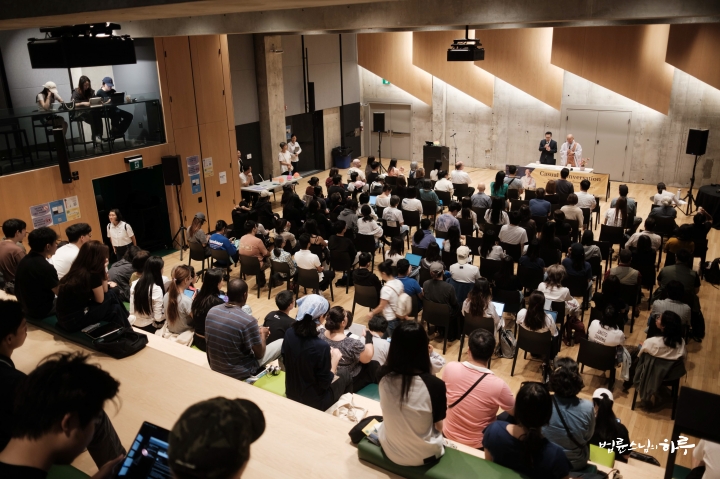
Approximately 200 attendees participated in the Dharma Q&A session. Photo by the Jungto Society.

From the mezzanine, I could see everything. Rows of black chairs fanning out the across pale wood floor, laptops glowing like small ponds, and a soft wash of light on the concrete wall. The room felt brighter the moment Sunim walked in. Shoulders loosened, smiles widened. People put their phones down. The room stilled. The room stilled.

He sat, glanced up, and slipped in a quick joke just enough to tip the mood from ceremonial to casual.
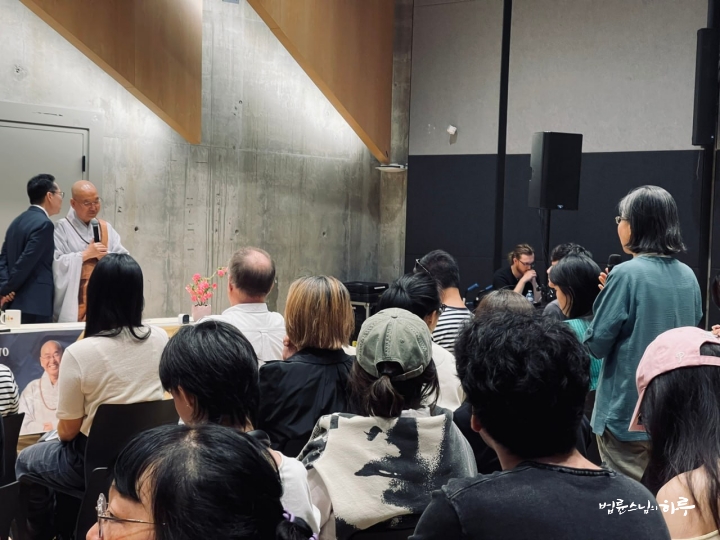
An audience member addressing a question to Ven. Pomnyun Sunim. Photo by the Jungto Society.

During the event, twelve questions were raised. Three questions circled around the same problems: how to overcome our frustrations, dissatisfactions, and grief.

I waited for a set of instructions or a hack for me to become enlightened, free from the suffering. He gave none.

Instead, he used an analogy and named the causes: desire and greed. His Korean words folded into English through the interpreter whose voice was soft but clear.

“Toddlers never feel frustration,” he said. “They fall. They get back up. Again.”

It isn’t mentally toughness; it’s a pure and clear heart, one with neither greed nor desire. Without those, frustration has nothing to cling on to in the child’s mind…

Oh yes, desires. How could suffering take root when there’s no desire? Let us slowly turn everyone into emotionless jellyfish; that ought to cure all pain and suffering from this world. No, I was not trying to outsmart the master. But I was resisting the theme in his answers.

I wanted to ask him: even if I know my desires are the cause of my suffering, how do I get rid of my desires? If I desire not to desire, isn’t that still a desire? And how do I get rid of that? Seems like it’s just turtles all the way down.
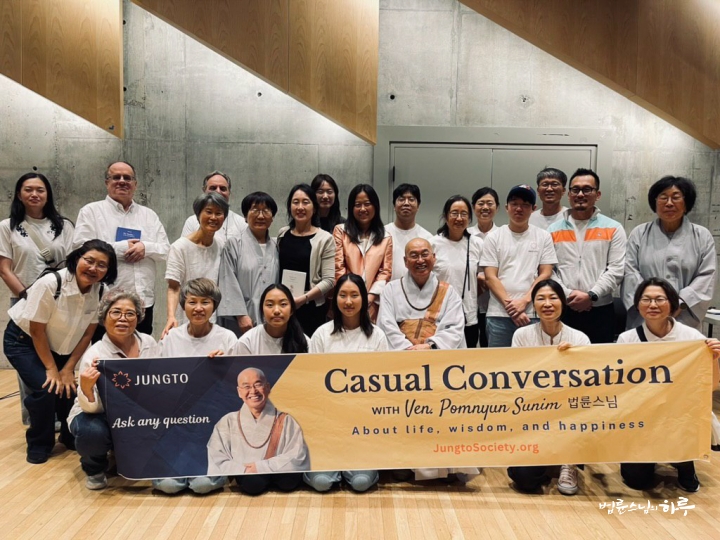
Commemorating a successful event with a final group photo with Jungto Society volunteers, Professors Sunyoung Ahn, Sinae Kim, and Seungjung Kim, with Ven. Pomnyun Sunim. Photo by the Jungto Society.

A few days later, I ducked into a tiny café near my place and ran into an old Korean friend. I told her I’ve met Pomnyun Sunim at UofT. She blinked, stunned, then laughed: “My father watches Sunim’s videos as soon as he gets home from work!”

I told her that although I met him and have great respect for the master, I just don’t find his answers helpful. She chuckled and added that although her father binges Sunim’s videos all the time, he would also disagree with Sunim’s view since the master has never been in his shoes. She thinks that her father mainly watches Pomnyun Sunim’s videos for entertainment.

A wild though flashes. Why wouldn’t he give us a strategy for how to get rid of our desire and greed?

Ven. Pomnyun Sunim is one of South Korea’s most respected and influential Buddhist teachers, known for his commitment to peace and social engagement. He’s the Master of Zen who lives out the Buddhist ethos. But is he more of an entertainer than educators? Or it is just the skillful means that he uses to attract more people? Why would the master only give us analogies and vague answers? Surely, a man of his stature can’t just be a sophist who hands out advice that only sounds convincing, but impractical. 
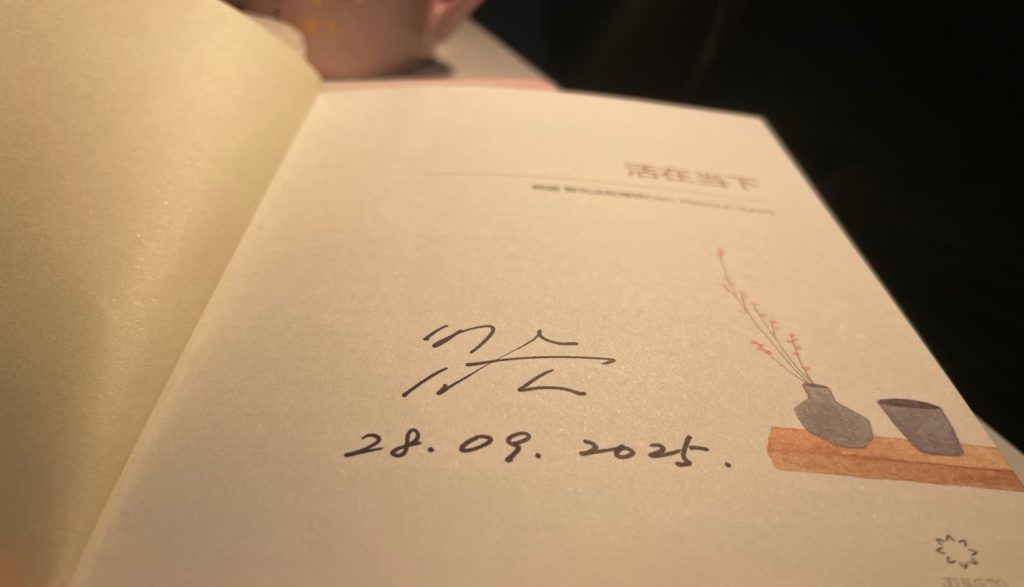
“True Happiness” by Ven. Pomnyun Sunim signed by Ven. Pomnyun Sunim. Photo by Samuel Li.

Later that night with my friend’s laugh was still in my ears, I was scrolling through YouTube and one video rose above the scroll: What Is the Essence of Buddhism? Ven. Pomnyun’s Dharma Q&A. In that video, a woman asked the master: “What is Buddhism?”

The master responded calmly and unbothered: “Well that answer varies depend on the person…”

Then, a beat of silence.

Like a seed cracking soil, the answer lifted into light. I realized the master was not avoiding a methodological answer out of a lack of virtue or understanding. Rather, he recognized that for some questions, all methodological answers he gives would be subjective because different people have different desires. By contrast, appealing to first principles and analogies are like planting seeds into the listener’s mind. The seeds germinate and take root in our hearts, giving us the mise to cook up our own hack past our problem.

I have never felt such potency from first principles and analogies. It was like a newborn shoot meeting the warm sun at last, bathing in the Zen.
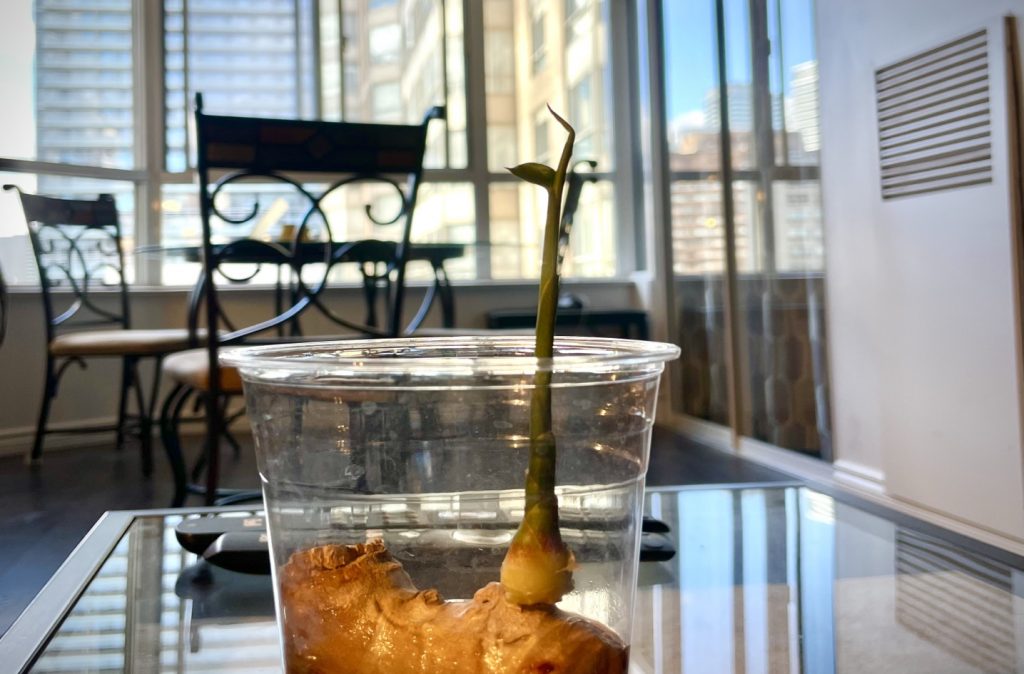
This is a photo of a ginger sprout thriving in my living room like the one’s that Zen master planted in my heart. Photo by Samuel Li.

In the end, I didn’t leave the talk with a panacea; I left with something quieter and stronger. A seed I can tend. It is not a hack, but it’s something that Zens.

Filed Under: Blog, Emaho! Blog, Undergraduate students Tagged With: Blog, student experience, Ven. Pomnyun Sunim

February 1, 2026

Postdoctoral Fellowship Position: Department for the Study of Religion & The Robert H.N. Ho Family Foundation Centre for Buddhist Studies  

Postdoctoral Fellowship Call for Applications 2026 PDFDownload PDF

The Robert H.N. Ho Family Foundation Centre for Buddhist Studies (Ho Centre) and the Department for the Study of Religion (DSR) at the University of Toronto invite applications for a one-year postdoctoral fellowship (renewable to a second year) in the study of Buddhism. Applicants should hold a PhD in the Study of Religion or a cognate field, awarded May 1, 2023, or later. See below for more details. 

We encourage applications from scholars working across a wide range of methods and time periods in Buddhist Studies (broadly defined), with a particular interest in interdisciplinary approaches. The successful candidate, however, must demonstrate sufficient proficiency in teaching Buddhism-related undergraduate courses in the Department for the Study of Religion. The initial appointment is for one year, from July 1, 2026, to June 30, 2027. Continuation into the second year is subject to a performance review; a renewal decision will be made by the end of January 2027.   

In addition to conducting research in their area of expertise, the Fellow’s responsibilities include:  

  • Teaching: 1.0 FCE (two courses) per year, one in the Department for the Study of Religion (DSR) at the St. George Campus and one in Historical & Cultural Studies at University of Toronto Scarborough (UTSC) campus. Opportunities to apply for paid summer teaching may be available for those seeking further pedagogical engagement.  
  • Ho Centre engagement: Contributing to Ho Centre initiatives, including pedagogy projects and/or public outreach.  
  • Public programming: Organizing and hosting a major public event, program, or conference of the Fellow’s design, in keeping with the Ho Centre’s mission. The theme and format of this event will be determined at the beginning of the appointment in consultation with the Ho Centre Director. 

The Fellow will be provided with workspace, library privileges, and full access to the University’s electronic resources. Postdoctoral Fellows are expected to be in residence and to contribute to the intellectual life of the academic community, including active participation in seminars, workshops, and other events, as well as in activities sponsored by the Ho Centre. The Postdoctoral Fellow will be jointly supervised by a faculty member in the Fellow’s research area (appointed by the DSR Chair) and the Ho Centre Director.  

The award is open to both domestic and international candidates. Successful international candidates must meet all Canadian immigration requirements and maintain a valid work permit throughout the term of the appointment.  

The Department for the Study of Religion is located at the University of Toronto, one of the world’s leading research universities. Building on the expertise of our faculty and the University’s extensive resources, the Department is uniquely positioned to support critical scholarship and excellence in teaching. We draw students from across the world and are situated in one of the most diverse metropolitan regions in North America, on the traditional lands of the Huron-Wendat, the Seneca, and the Mississaugas of the Credit River. 

The Robert H. N. Ho Family Foundation Centre for Buddhist Studies (Ho Centre) promotes excellence in research and teaching in Buddhist Studies across all three University of Toronto campuses and is administered within the Department for the Study of Religion at the St. George campus. The Ho Centre’s programs and events examine how Buddhist traditions have grown and developed, how they have been interpreted and transformed, and how they can be studied with scholarly rigor in a religiously plural environment. Please note that the Ho Centre will celebrate its 10th anniversary in 2026–2027; the Fellow will be expected to contribute actively to anniversary programming.  

Salary: $63,000 (plus benefits)   

Application Deadline: February 20, 2026 

To apply, please send your application with the following information (in a single PDF document) to Tanya Proulx, Chair’s Assistant and Office Administrator, via email: tanya.proulx@utoronto.ca:   

  • Statement of Interest describing your professional and academic experience and proposed research project. The statement should also outline your plans to contribute to the intellectual life of the Ho Centre and the DSR and include a preliminary idea for a public-facing event/program/conference to be sponsored by the Ho Centre.  
  • CV   
  • List of DSR courses interested in teaching and one sample syllabus   
  • Teaching Statement of no more than 2 pages   
  • Two Letters of Recommendation (to be sent directly to tanya.proulx@utoronto.ca). If candidate is currently ABD, please make sure the letter specifies a projected dissertation completion date (dissertation defense and final submission must be made before June 30, 2026).  

Eligibility to Apply: 

The award is open to both domestic and international post-graduates. Successful international candidates must meet all Canadian immigration requirements before taking up the award.  

Nominees Must:  

  • Have completed all requirements for their doctorate degree no earlier than May 1, 2023. (If your career was significantly interrupted after completing your doctorate due to extenuating circumstances, you may qualify for an extension of the eligibility period. Eligible career interruptions may include parental, medical and/or family-related responsibilities, mandatory military service, disruptions due to war, civil conflicts or natural disasters in your country of residence or limited research opportunities due to socio-economic reasons. The eligibility period can be extended by the duration of the eligible delay(s)/interruption(s). “Career interruption” refers to a period of time when you were not working (full-time or part-time) and when your research was completely interrupted. If this applies, applicants should add a section at the end of their CV describing special circumstances and career interruptions.)  
  • Not hold or be on leave from a tenure-track or tenured faculty position. Generally, “tenure or tenure-track” refers to an open-ended academic position in which the holder can form a research group, apply for externally funded research as a principal investigator and teach.  
  • Not hold concurrently another major fellowship.  

FTE (Full-Time Equivalent):   

The normal hours of work are 40 hours per week for a full-time postdoctoral fellow (pro-rated for those holding a partial appointment) recognizing that the needs of the employee’s research and training and the needs of the supervisor’s research program may require flexibility in the performance of the employee’s duties and hours of work.  

Employment as a Postdoctoral Fellow at the University of Toronto is covered by the terms of the CUPE 3902 Unit 5 Collective Agreement.  

This job is posted in accordance with the CUPE 3902 Unit 5 Collective Agreement.  

The University of Toronto is strongly committed to diversity within its community and especially welcomes applications from racialized persons / persons of colour, women, Indigenous / Aboriginal People of North America, persons with disabilities, LGBTQ2S+ persons, and others who may contribute to the further diversification of ideas. 

Download PDF of the Call for Applications

Filed Under: Announcements, News Tagged With: fellowship, funding, postdoc, research support

December 19, 2025

Our tribute to Mr. Robert Hung Ngai Ho, C.M., O.B.C.

“My master told me that there are many ways to be a good Buddhist. He advised me to be comfortable with my own path,” Robert H. N. Ho (quoted in an interview with Raymond Lam, 1 Jan 2014, Buddhistdoor Global)

It is with deep sadness that we share the news that Mr. Robert Hung Ngai Ho passed away on November 30, 2025, in Vancouver, BC.

A private funeral was held in Vancouver followed by cremation. Buddhist prayer services officiated by Abbot Venerable Tsang Chit was held at Tung Lin Kok Yuen in Vancouver on December 16, 12:30 p.m. This was followed by a “Celebration of Life” drinks reception at 5:00 p.m. at the Fairmont Pacific Rim Hotel, Canada Place, Vancouver. Buddhist prayer services will also be held in Tung Lin Kok Yuen Hong Kong on December 20, 7:00 p.m. A condolence book will be available at both Tung Lin Kok Yuen in Vancouver and Hong Kong.


Mr. Ho’s legacy of making Buddhist wisdom and practice relevant to contemporary society includes establishing the Tung Lin Kok Yuen Canada Society and temple in Vancouver; endowing several universities to build centres for Buddhist Studies; supporting advanced study and the dissemination of knowledge of Buddhist traditions through a suite of fellowships, grants, and professional development programs administered by the American Council of Learned Societies; and establishing medical research centres, including the construction of a mental health centre in North Vancouver.

He established the Robert H. N. Ho Family Foundation in 2005 in Hong Kong to support programs in arts and culture and Buddhism, and to fund initiatives that enhance the wellbeing of humanity and the environment.

In 2006, Mr. Ho provided an endowment of $4 million to the University of Toronto Scarborough, marking a significant financial commitment to Buddhist Studies at the University. His gift has elevated the field to new heights. Through his vision and generosity, Buddhist Studies at the University of Toronto has grown from a cluster of strong individual programs into one of the leading academic hubs for the study of Buddhism in North America. His endowment created the conditions for sustained research excellence, community engagement, and the training of future scholars.

Initially, the gift supported a variety of projects at UTSC, including a visiting professorship, a lectureship program, a conference, a public lecture series, and new scholarship funding. In 2016, the University approved the use of the endowment to launch the Robert H. N. Ho Family Foundation Centre for Buddhist Studies as a university-wide hub, with its administrative home in the Department for the Study of Religion in the Faculty of Arts & Science.

Over the past decade, Mr. Ho’s gift has been at the heart of the University’s established strength in Buddhist Studies, advancing research and teaching across a wide range of topics, from history and medicine to philosophy, art, and practice. The field has grown both in numbers and expertise, with more faculty dedicated to Buddhist Studies research and teaching. U of T now enrolls more than two thousand undergraduate students annually in Buddhist Studies courses across several academic programs, including the Buddhist Studies Major and Specialist programs in the Department for the Study of Religion; the Minor in Buddhism, Psychology, and Mental Health at New College; and the Major, Minor, and Specialist programs in Global Asia Studies at UTSC. Graduate students pursue Buddhism-focused research in MA and PhD programs in Art History, East Asian Studies, Philosophy, Political Science, Religion, and other units.

Emmanuel College of Victoria University in the University of Toronto offers Compassionate Canopy, a Buddhist continuing education program for ministry professionals, in partnership with the Buddhist College of Canada. This year, Trinity College established the Institute for Humanistic Buddhist Thought and Practice in its Faculty of Divinity. In addition, fourteen active student groups across the University focus on Buddhism, meditation, and mindfulness, contributing to a vibrant co-curricular community.

Numerous collaborations and projects have further nourished the growth of Buddhist Studies at the University. These include a partnership between Columbia University’s Tibetan collection services and the University of Toronto Libraries; three scholarship funds designated to support Buddhist Studies graduate students and Tibetan Language instruction in the Department for the Study of Religion; and the Yehan Numata Program in Buddhist Studies, co-hosted with McMaster University. The Centre also supports the Canadian Journal of Buddhist Studies.

Today, the Centre stands as a dynamic, interdisciplinary hub that embodies Mr. Ho’s commitment to making Buddhist wisdom accessible and relevant. Our programs draw scholars, students, and members of the public from Canada and abroad, reflecting the University’s leadership in global Buddhist Studies.

We endeavor to remain closely connected to the undergraduate and graduate students on all three campuses of the University whose work continues to be shaped by Mr. Ho’s vision. The Centre supports the many students, researchers, and initiatives across the University that reflect the depth and breadth of Buddhist Studies at U of T. Our strength lies in offering creative and innovative opportunities for collaboration through events and programs that invite scholars and the public into deeper understanding.

We are honoured to be part of the international network of institutions strengthened by the generosity of The Robert H. N. Ho Family Foundation. In keeping with Mr. Ho’s belief that one should “be comfortable with one’s own path,” his legacy endures in the vibrant scholarly community he helped build. His vision continues to inspire us as we foster diverse approaches, encourage open inquiry, and help Buddhist Studies researchers find their own paths at the University of Toronto for generations to come.

Filed Under: News Tagged With: Blog, donor, Ho Family Foundation, Robert HN Ho

December 10, 2025

In memoriam: Mr. Robert Hung Ngai Ho, C.M., O.B.C

Mr. Robert Hung Ngai Ho, 1932 – 30 November 2025

Our benefactor Mr. Robert Hung Ngai Ho passed away on November 30, 2025 in Vancouver, BC.

Mr. Ho’s work in Buddhism focused on making Buddhist wisdom and practice relevant to contemporary society, while also strengthening Buddhist studies programs at universities in Hong Kong and North America. 

He established the Robert H.N. Ho Family Foundation, which supports programs in arts and culture and Buddhism, and funds initiatives that enhance the wellbeing of humanity and the environment. His donation to the University of Toronto became what is now our Centre, the intellectual home for faculty and students in Buddhist studies across the University’s three campuses. 

His significant contributions to Canada were formally recognized through his appointments to both the Order of British Columbia and the Order of Canada.

Please send remembrances and tributes to buddhiststudies@utoronto.ca.

We invite you to read the tribute to his legacy on the Department for the Study of Religion website.

Another statement to his generous philanthropy is also available at Buddhistdoor Global, and his obituary is available on Tung Lin Kok Yuen.

In Loving Memory of Mr. Robert H. N. Ho (1932–2025): Philanthropist, Buddhist Benefactor, and Founder of Buddhistdoor Global

Filed Under: News Tagged With: donor, Ho Family Foundation, Robert HN Ho

April 10, 2025

In Memoriam: Dr. Michael Ium

It is with deep sadness that we share the news of the passing of Dr. Michael Ium, a cherished colleague, scholar, and friend to many in our academic community.

Michael was born and raised in Toronto, the child of South Korean immigrants. He went on to complete degrees at the University of Toronto (B.Sc.), Maitripa College (M.A.), and the University of California, Santa Barbara’s Department of Religious Studies (M.A., Ph.D.). A historian of religion, his research focused on the religions of Tibet and South Asia, with particular attention to the early history of the Geluk tradition in Tibet.

In addition to advancing the academic study of Buddhism in Canada, Michael was deeply interested in what makes the Canadian Buddhist context unique—whether Canada’s multicultural framework or Buddhism’s theological engagement with other religious communities.

Michael held the distinction of being the first postdoctoral fellow jointly appointed in the Department for the Study of Religion and the Ho Centre for Buddhist Studies at the University of Toronto, where he quickly became a vibrant and deeply valued presence. In 2024, he began a postdoctoral fellowship at the Institute for Cultural and Intellectual History of Asia at the Austrian Academy of Sciences (OeAW), where he was part of the European Research Council–funded project TibSchol: The Dawn of Tibetan Buddhist Scholasticism.

He also served as co-editor of the Canadian Journal of Buddhist Studies, contributing both his scholarly insight and collegial generosity to the field.

Michael’s warmth, enthusiasm, and scholarly dedication left a lasting impression on all who had the privilege of working with him. He will be profoundly missed—for his intellectual contributions and for the spirit of collegiality and kindness he brought to our community. Professor Rory Lindsay has been in contact with those close to Michael, and we will provide an update on plans for a memorial as they become available. Our thoughts are with his family, friends, and all who are mourning this sudden and heartbreaking loss.

Filed Under: Announcements, News

  • 1
  • 2
  • 3
  • …
  • 6
  • Next Page »
logo for U of T Robert H.N Ho family foundation center for buddhist studies
The Robert H. N. Ho Family Foundation

The University of Toronto operates on land that for thousands of years it has been the traditional land of the Huron-Wendat, the Seneca, and  the Mississaugas of the Credit. Today, this meeting place is still the home to many Indigenous people from across Turtle Island and we are grateful to have the opportunity to work on this land. Learn more about this history.

Copyright © 2026