Learn | Explore | Connect

at the University of Toronto

  • About Us
    • About Us
    • Our Mission
    • Personnel
  • Events
    • Events
    • Past Events
  • Funding
    • Funding
    • Phool Maya Chen Scholarship
    • Machik Ödrön Fund for Tibetan Language
    • Bill and Belle Levman Graduate Award
  • Programs
    • Learning Languages
      • Tibetan Studies
    • The Circled Square Podcast
    • Engaging Education in Buddhist Studies
    • Canadian Journal of Buddhist Studies
    • Mentoring Matters
    • Student Flourishing
  • Community
    • Faculty & Teaching Staff
    • Post Doctoral Fellow
    • Research Partners
    • Students
    • Alumni
  • Emaho! Blog
You are here: Home / Archives for uoftcbs

October 28, 2016

Connecting art and religion

By Daigengna Duoer

This year, I was incredibly fortunate to have the chance to participate in a field trip to Dunhuang, China as one of the lucky students enrolled in the ‘Making Pictures in Medieval China’ course offered at the Art History Department of the University of Toronto. Led by professor Jenny Purtle and funded by the Getty Foundation and as part of the ‘Global and Postglobal Perspectives on Medieval Art and Art History’, a three-year collaborative initiative that aims to connect art histories and increase international intellectual exchange, the field trip to Dunhuang was the perfect way to wrap up the amazing learning experience.
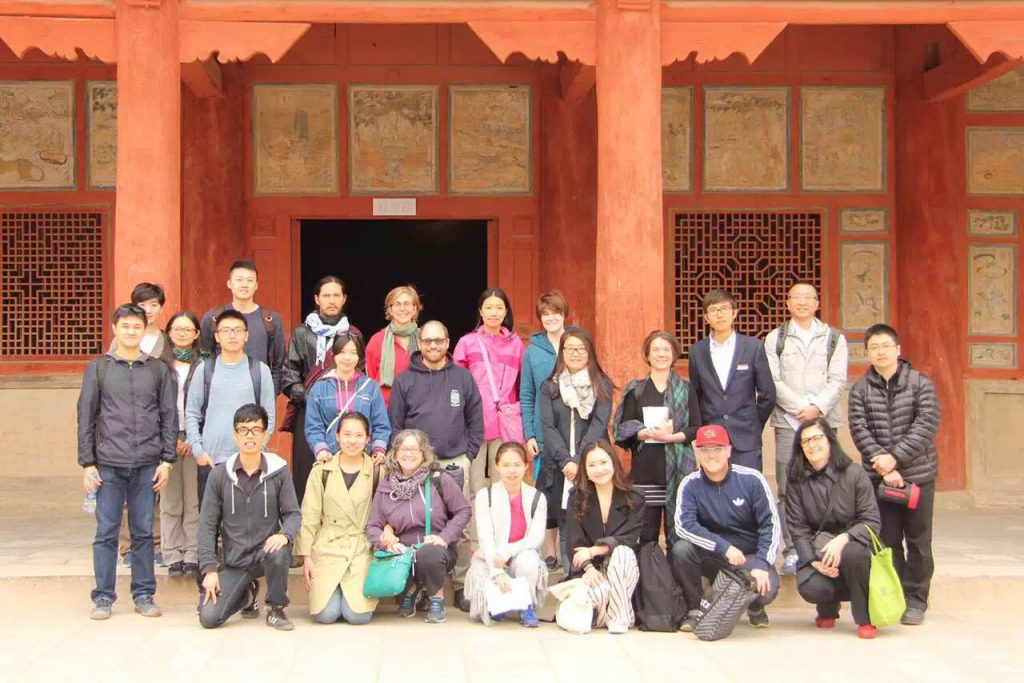
Daigengna and fellow program participants in Dunhuang

Taught by guest professor Yudong Wang of the Guangzhou Academy of Fine Arts (GAFA) in China, who was also one of the supervising scholars on the trip, the course ‘Making Pictures in Medieval China’ covered diverse topics on Medieval Chinese Art, from early medieval funerary objects in Central China to late medieval Buddhist art on the Silk Road. Dunhuang, as one of the most significant sites of Buddhism and Buddhist art in China, was of course the main focus of the course and the destination of our class field trip.

Under the supervision and guidance of U of T scholars Jenny Purtle, Jill Caskey, Linda Safran and Adam Cohen along with GAFA scholars Yudong Wang, Qingquan Li, and Qingquan Zou, students from U of T lived, studied, and collaborated with students from GAFA over the course of ten days from May 15 to 25 in Dunhuang. We visited more than thirty caves at the Mogao Grottoes and at the Yulin Grottoes, many of which were not often open to the public. Students from U of T and GAFA prepared presentations everyday to be given on site. For each cave that we visited, two or more presentations were performed on different aspects of the cave, such as its history, painting technique, iconography and religious significance. In addition, the students from U of T also presented their final term papers in the specific caves that they researched on. Another M.A. student from our department and my fellow colleague in Buddhist Studies, Shum Cheuk Shing also participated in the field trip and presented his paper on the Hindu deities painted on both sides of the main Buddha sculpture in Mogao cave 285. I presented my paper “Patrons of the Steppes: A Look into the Mongol Presence at the Dunhuang Mogao Grottoes” on one of the most esoteric caves at Mogao – cave 465. I was supremely honored to be able to share my research with my peers right inside the cave, which has not been opened to the public since the 1980s due to its sensitive content and history. In my paper and presentation, I problematized the conventional dating of cave 465 to the Mongol Yuan Dynasty and suggested that it was a cave maintained in a combination of efforts of different cultures of people from different dynasties but under the same politico-religious agendas. I clarified the relationship between the Xixia Kingdom (when the cave was first constructed) and the Mongol Yuan Empire (when additional donor paintings and inscriptions were added to the cave) and focused on how Tibetan Buddhism became a highly politically practical tool for the making and ruling of both imperial states.

The students on the trip from both institutions of U of T and GAFA came from different disciplines. While most participants on the trip were graduate students of Medieval Art History, there were also a few participants from different disciplines such East Asian Studies and Religious Studies who work on Chinese Art and/or Buddhism. It was incredibly interesting and invaluable to see the various approaches to methodology taken by students of different academic backgrounds. Out of impassioned discussions and our collaborative efforts to construct global and postglobal perspectives on Art History, Dunhuang emerged at the end as a perfect site to negotiate issues of the global vs. the postglobal and as a remarkably relevant field in which more interdisciplinary collaborations between international scholars of history, art, and religion should be encouraged.

Daigengna Duoer is a second year M.A. student at the Department for the Study of Religion. She studies Mongolian Buddhism and is interested in the relationship between Buddhism, politics, and ethnic identities in modern and contemporary Inner Mongolia.


Filed Under: Featured, Stories from Our Students

September 29, 2016

Discovering India, discovering myself

By Brittany Rizzo

We have finally made it to India and I am starting to understand the reason why people become severely addicted to traveling. There is obviously some enjoyment that can be experienced from being in a new place and perceiving a new culture. However, it is plausible that what is really meritorious about travelling is that it helps you understand and appreciate yourself in greater ways. Back home in Toronto, it is easy to forget who you are because you become lost in a monotonous crowd of accomplishing the daily grind. This may include finishing your education at the top of your class, making enough money to pay for rent in a ridiculously expensive city, and purchasing the most recent material items to show your friends that you are worth something. You are never really given the opportunity to discover who you are and what you are made of. It may seem cheesy and obvious to state this, but it definitely should be mentioned and not discounted. There are many things that I have witnessed up until this point that have really helped me in this aforementioned process of understanding who I am.

From my previous post, you can tell that the trip already had such a rough start. But, this just made the landing in Bagdogra all the more satisfying. Seeing Frances’ face was like finally eating after days of fasting. I am not sure how I remained so strong throughout the entire process, but I did. I took a breath of the Indian air and I felt like I could accomplish anything in that moment. That was until I saw the toilets in the Bagdogra airport. They were literally holes in the floor with a sprayer beside it. Obviously, they have not been cleaned in quite a bit of time and I had to decide in that moment, do I complete the task or do I move on and wait for another opportunity. Even though it was not something I am use to nor something I quite enjoy, I took the plunge and used my first Indian toilet. Just another experience that has really made me learn more about myself.

At the Bagdogra airport, we were greeted by monks from the Lingdum monastery high in the mountains. They brought us to their cars and the adventure through India began. I noticed right away the exceptionally different method of driving here. There is no concept of right of way or lanes. Essentially, beeping at cars, people or motorcycles around you gives them the signal to let you through and you maneuver around them. Of course, this made the driving incredibly disorienting and nerve wracking. I really held on to the side of the car and I had to keep telling myself not to puke all over the monk beside me. I do not think that would give me any sort of merit. The cars and scenery around me made it a lot easier to distract myself. All of the cars driving by were painted beautifully in primary colours, each a one of a kind. And to match the cars, all of the buildings were painted in similar colours. It was as if I entered a colourful wonderland, one that is enchanted with all sort of mystical powers. Also, as we were driving through the mountains, the wildlife was all around us. This took African Lion Safari to a whole new level. There were packs of monkeys sitting on the side of the road, as if it were their casual hang out spot. This is the jungle.

Unfortunately though, it got even worse after we entered Sikkim and headed for the monastery, which was about an hour away. Up until this point, the roads were curvy and near the edge of the mountains, but there was always a fence guarding us from a sudden fall to our death. So, it never really felt unsafe. But, as we approached the area of the Lingdum monastery, it became very dark, the roads became a lot smaller and the fence guarding us seemed to disappear. There were points going up this mountain where the car wheels were just about over the road and heading down the hill. I was amazed at how calm I was and what a great driver the monk was. At one point, we even had to drive through a water fall. The water was falling from the side of the mountain, leaving a strong current on the road. We needed to drive through it fast and cautious enough so the current did not take us with it.

Finally, after some serious height and altitude, we made it to the entrance doors of the monastery. It was like nothing I have ever seen before. I didn’t feel like I was about to enter a real monastery. I have read and studied them for several years now but it is one thing to study something and another to experience it first hand. Immediately, I fell in love. How does something like this exist in this world? The world I know is full of greed, lust, hate and trickery. A world where the opportunity for success seems to come at the cost of happiness. But, upon entry into this monastery, that other world was left behind. I am now in the new world, one more simplistic, sincere and honest.

It was too dark to really explore the grounds so I decided after the journey I have had so far, I should rest for the night. I was awoken at 4 am by chanting and bells from the main building. Unlike other places I have been to where I was woken by sounds of water or birds, this was very unusual. But, somehow, in someway, it made me feel comforted and at peace so I slowly drifted back into sleep. At 6 am, I woke back up again to start my day in this new world. My first task was to get clean and eat. One of those was definitely easier than the other. I entered the bathroom and I was a little taken back by what I saw. There was a toilet and a shower on opposite sides of this square room without any separation. I saw a drain and I realized that the whole room is really the shower and the water eventually drains out. I turned on the shower and only yellowy cold water came out. I couldn’t not shower! I smelled of airplane food and sweat. It was not a great situation. So, with the biggest need to get clean, I stuck my body under the cold water and began to shower. It was such an initial shock to my system and it was not easy. After I was done, I felt like I just ran a marathon. I was so pleased with myself. I washed my clothes by hand under the sink, got changed and went to breakfast.

As I was staring into the mountains in the distance, I began to think about why I was so proud of myself and why I felt accomplished. It made me realize that these common things like hot water, or a seated toilet, are really not necessary. People have lived before without them and they can live now without them as well. It made me start to question all of the things in my life that I felt were absolutely required and I started to realize that I could realistically spend the rest of my life in this monastery. I do not really need these “luxuries”. All I need is to be happy. Therefore, even though I am proud of getting through these cultural changes, I shouldn’t be. In fact, I should be disappointed that we have made our lives so easy in Canada that we cannot experience this satisfying feeling of overcoming something for ourselves. If you fight for something, your success is all the more satisfying. I think the saying goes, it is not about the destination but about the journey.

Anyway, this is just what travel is all about; expanding the world that you once knew. I now know I can live a more ascetic life if I choose to do so. But, maybe I won’t jump into that all too soon.

Brittany Rizzo was an undergraduate in Buddhist Studies. She graduated in 2016 and is now in law school. You can read more about her trip to India at Encounters in Sikkim.

Filed Under: Featured, Stories from Our Students

  • « Previous Page
  • 1
  • …
  • 4
  • 5
  • 6
logo for U of T Robert H.N Ho family foundation center for buddhist studies
The Robert H. N. Ho Family Foundation

The University of Toronto operates on land that for thousands of years it has been the traditional land of the Huron-Wendat, the Seneca, and  the Mississaugas of the Credit. Today, this meeting place is still the home to many Indigenous people from across Turtle Island and we are grateful to have the opportunity to work on this land. Learn more about this history.

Copyright © 2026