Submitted by Samuel Li
A soft afternoon light pooled over campus when my phone buzzed, a friend texted “Zen talk at U of T this weekend—Wanna come?”
When the mic clicked on, I leaned forward like everyone else, ready for a silver bullet. What I got instead was a pause long enough to hear my own wanting. And then, a lesson about desire.
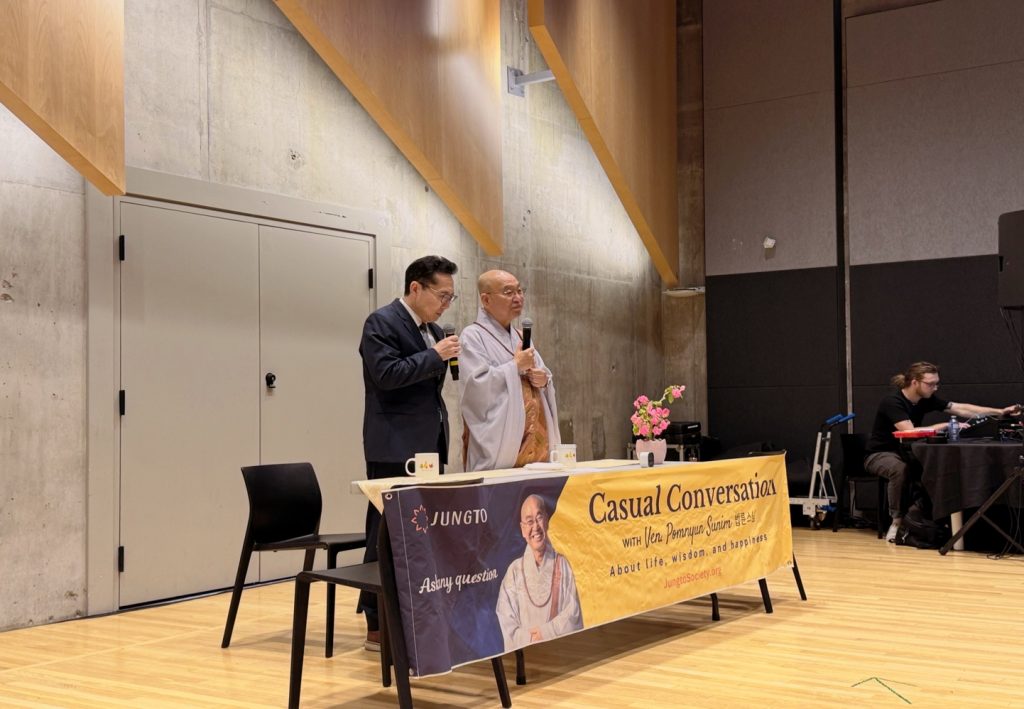
On September 28, 2025, the Robert H. N. Ho Family Foundation Centre for Buddhist Studies at the University of Toronto (HCBS) hosted a Dharma Q&A with Venerable Pomnyun Sunim, renowned Korean Zen master and founder of Jungto Society. During the 90-minute session, audience members were invited to ask questions directly to Ven. Pomnyun Sunim, prompting discussions about how Buddhist teachings can be applied to everyday life.
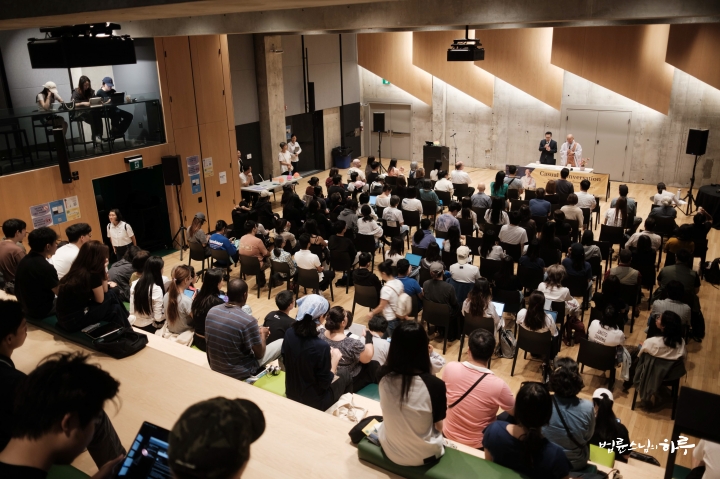
From the mezzanine, I could see everything. Rows of black chairs fanning out the across pale wood floor, laptops glowing like small ponds, and a soft wash of light on the concrete wall. The room felt brighter the moment Sunim walked in. Shoulders loosened, smiles widened. People put their phones down. The room stilled. The room stilled.
He sat, glanced up, and slipped in a quick joke just enough to tip the mood from ceremonial to casual.
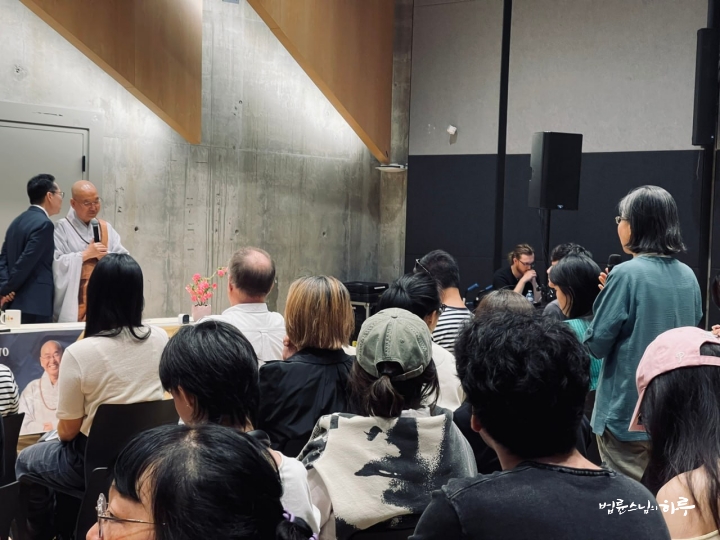
During the event, twelve questions were raised. Three questions circled around the same problems: how to overcome our frustrations, dissatisfactions, and grief.
I waited for a set of instructions or a hack for me to become enlightened, free from the suffering. He gave none.
Instead, he used an analogy and named the causes: desire and greed. His Korean words folded into English through the interpreter whose voice was soft but clear.
“Toddlers never feel frustration,” he said. “They fall. They get back up. Again.”
It isn’t mentally toughness; it’s a pure and clear heart, one with neither greed nor desire. Without those, frustration has nothing to cling on to in the child’s mind…
Oh yes, desires. How could suffering take root when there’s no desire? Let us slowly turn everyone into emotionless jellyfish; that ought to cure all pain and suffering from this world. No, I was not trying to outsmart the master. But I was resisting the theme in his answers.
I wanted to ask him: even if I know my desires are the cause of my suffering, how do I get rid of my desires? If I desire not to desire, isn’t that still a desire? And how do I get rid of that? Seems like it’s just turtles all the way down.
A few days later, I ducked into a tiny café near my place and ran into an old Korean friend. I told her I’ve met Pomnyun Sunim at UofT. She blinked, stunned, then laughed: “My father watches Sunim’s videos as soon as he gets home from work!”
I told her that although I met him and have great respect for the master, I just don’t find his answers helpful. She chuckled and added that although her father binges Sunim’s videos all the time, he would also disagree with Sunim’s view since the master has never been in his shoes. She thinks that her father mainly watches Pomnyun Sunim’s videos for entertainment.
A wild though flashes. Why wouldn’t he give us a strategy for how to get rid of our desire and greed?
Ven. Pomnyun Sunim is one of South Korea’s most respected and influential Buddhist teachers, known for his commitment to peace and social engagement. He’s the Master of Zen who lives out the Buddhist ethos. But is he more of an entertainer than educators? Or it is just the skillful means that he uses to attract more people? Why would the master only give us analogies and vague answers? Surely, a man of his stature can’t just be a sophist who hands out advice that only sounds convincing, but impractical.
Later that night with my friend’s laugh was still in my ears, I was scrolling through YouTube and one video rose above the scroll: What Is the Essence of Buddhism? Ven. Pomnyun’s Dharma Q&A. In that video, a woman asked the master: “What is Buddhism?”
The master responded calmly and unbothered: “Well that answer varies depend on the person…”
Then, a beat of silence.
Like a seed cracking soil, the answer lifted into light. I realized the master was not avoiding a methodological answer out of a lack of virtue or understanding. Rather, he recognized that for some questions, all methodological answers he gives would be subjective because different people have different desires. By contrast, appealing to first principles and analogies are like planting seeds into the listener’s mind. The seeds germinate and take root in our hearts, giving us the mise to cook up our own hack past our problem.
I have never felt such potency from first principles and analogies. It was like a newborn shoot meeting the warm sun at last, bathing in the Zen.

In the end, I didn’t leave the talk with a panacea; I left with something quieter and stronger. A seed I can tend. It is not a hack, but it’s something that Zens.